
Organisational structure
Abstract
The Insurance Regulatory Authority (IRA) of Uganda, established under the Insurance Act, 2017, serves as the primary regulator and supervisor of the Ugandan insurance industry. Its organizational structure is designed to ensure effective administration, prudential oversight, and market development, while safeguarding policyholder interests. This article delves into the IRA's foundational legal framework, its governance through a Board of Directors and a Chief Executive Officer, and the departmental structure that executes its mandate, highlighting the critical role this framework plays in fostering a stable, transparent, and inclusive insurance sector in Uganda.
Introduction
The Insurance Regulatory Authority (IRA) of Uganda stands as a cornerstone of the nation's financial sector, tasked with the crucial responsibility of overseeing and developing the insurance industry. Established by an Act of Parliament, the IRA's mandate extends to ensuring the effective administration, supervision, regulation, and control of all insurance business within Uganda. The integrity and efficiency of this regulatory body are intrinsically linked to its organizational structure, which dictates how its statutory functions are executed and how it interacts with licensed entities and the public.
Understanding the IRA's organizational structure is paramount for legal professionals and practitioners operating within Uganda's insurance landscape. It provides insight into the decision-making hierarchy, the allocation of responsibilities, and the channels through which regulatory compliance is monitored and enforced. This article will explore the legal basis for the IRA's structure, detail its key administrative components, and analyze the implications of this framework for the broader insurance market and its stakeholders.
Background
The genesis of the Insurance Regulatory Authority of Uganda dates back to 1997, following the government's policies of liberalization and privatization, which shifted its role from direct service provision to that of a supervisor and regulator. The IRA's existence and powers are primarily enshrined in the Insurance Act, 2017 (Act No. 6 of 2017), which repealed the earlier Insurance Act, Cap. 213, and consolidated the legal framework for insurance in Uganda. Section 10 of the Insurance Act, 2017, specifically provides for the continuance of the Insurance Regulatory Authority of Uganda, outlining its objectives and functions.
Under the Act, the IRA is mandated to ensure a safe, sound, and sustainable insurance market, protect policyholders' interests, and promote the development of the insurance sector. Its functions include licensing and supervising insurers, reinsurers, brokers, agents, and other intermediaries, enforcing solvency standards, approving products and rates, handling consumer complaints, and developing regulatory frameworks. The Authority operates under the oversight of the Ministry of Finance, Planning and Economic Development, underscoring its role within the broader national financial regulatory architecture.
Analysis
The organizational structure of the Insurance Regulatory Authority of Uganda is bifurcated into a policy-setting Board of Directors and an executive management team led by the Chief Executive Officer, supported by various specialized departments. Section 14 of the Insurance Act, 2017, establishes the Board of the Authority, detailing its composition, appointment process by the Minister of Finance, Planning and Economic Development, and functions, which include providing strategic direction and institutional accountability. As of March 2026, Ms. Keto Kayemba chairs the Board, with Ms. Grace Mugabiire serving as Vice Chairperson.
Executive leadership is vested in the Chief Executive Officer (CEO), whose functions are outlined in Section 22 of the Insurance Act, 2017. The CEO is responsible for the day-to-day operational implementation of the IRA's mandate, including licensing, supervision, and market development initiatives. Following the expiry of Alhaj Dr. Kaddunabbi Ibrahim Lubega's contract, Dr. Protazio Sande was appointed as the Acting Chief Executive Officer in June 2026. This dual-tier governance structure ensures both strategic oversight and efficient operational execution.
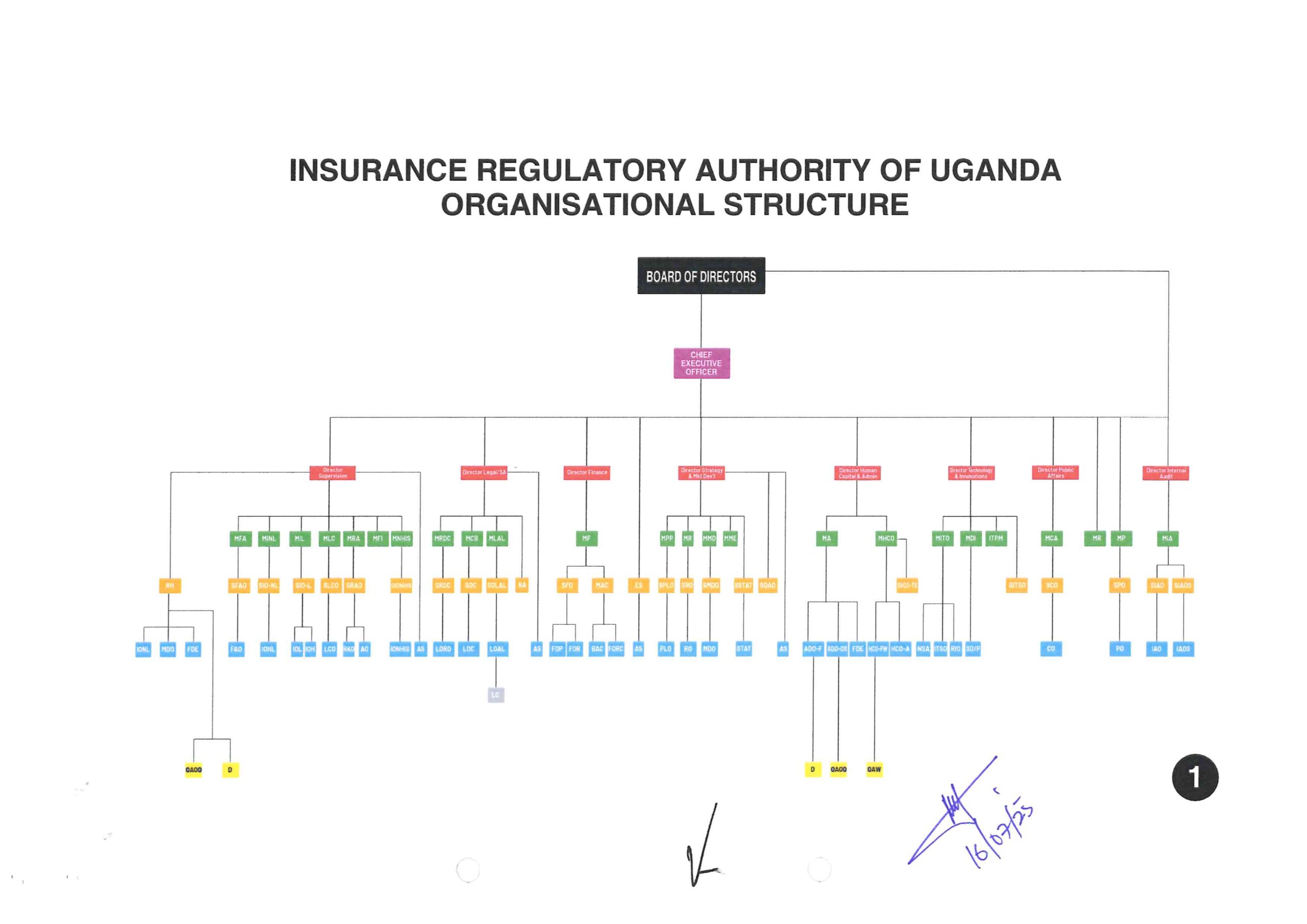
Beneath the CEO, the IRA is organized into several directorates and departments, as illustrated by its organogram. These typically include departments for Supervision (covering financial analysis and inspections for both life and non-life business), Legal/Board Secretariat, Finance, Strategy & Market Development, Human Capital & Administration, Technology & Innovations, Public Affairs, and Internal Audit. This departmentalization allows for specialized expertise in critical areas such as prudential regulation, market conduct, consumer protection, and the development of new insurance products like Takaful and Retakaful, which were recently introduced through new regulations in December 2025.
The IRA's structure facilitates its risk-based supervision approach, enabling it to monitor compliance, enforce solvency standards, and mitigate risks such as fraud within the sector. The Authority also collaborates with other key financial sector regulators and government agencies, including the Bank of Uganda, Capital Markets Authority, and the Ministry of Finance, Planning and Economic Development, to ensure a coordinated regulatory environment. This collaborative approach, centralized from its headquarters in Kampala, is crucial for addressing systemic risks and promoting uniform application of regulations across the country.
Conclusion
The robust organizational structure of the Insurance Regulatory Authority of Uganda is fundamental to its effectiveness in fostering a stable, transparent, and growing insurance market. The clear delineation of roles between the Board of Directors, the Chief Executive Officer, and specialized departments ensures comprehensive oversight, strategic direction, and efficient operational execution of its statutory mandate under the Insurance Act, 2017.
For legal practitioners and insurance entities, understanding this structure is vital for navigating the regulatory landscape, ensuring compliance, and engaging effectively with the Authority. Practitioners should remain abreast of changes in leadership, such as the recent appointment of the new Board and Acting CEO, and be familiar with the functions of the various departments to streamline interactions and address regulatory matters efficiently. Continued adherence to the IRA's guidelines and active participation in industry developments, facilitated by the Authority's structured approach, will be key to sustainable growth and maintaining public confidence in Uganda's insurance sector.
Citations
- 1.Insurance Act, 2017 (Act No. 6 of 2017)
- 2.The Insurance Regulatory Authority of Uganda - Wikipedia
- 3.Insurance Regulatory Authority of Uganda - Grokipedia
- 4.How Magezi Ibale & Co. Advocates Helps Clients Navigate Insurance Law in Uganda
- 5.Role of Uganda's Insurance Regulatory Authority | PDF - Scribd
- 6.Uganda Insurance Act, 2017 | Africa Commons
- 7.The Insurance Regulatory Authority of Uganda | https://www.ubuntumarketafrica.com
- 8.Insurance Act 2017.pdf - Parliament of Uganda: Bill Tracker
- 9.URBRA and IRA Boards Inaugurated to Strengthen Uganda's Financial Sector - Jonard Post
- 10.The Board - The Insurance Regulatory Authority of Uganda
- 11.Regulation of Uganda's Insurance Industry | PDF - Scribd
- 12.The Insurance Act, 2017 : Uganda government. act no. 6 of 2017
- 13.CHANGE OF GUARD: IRA RECEIVES NEW BOARD MEMBERS
- 14.board of directors - chief executive officer - The Insurance Regulatory Authority of Uganda
- 15.ORGANISATION STRUCTURE - The Insurance Regulatory Authority of Uganda
- 16.The Insurance Regulatory Authority of Uganda: Home
- 17.To create an enabling regulatory environment for sustainable growth of the insurance industry while upholding best practices.
- 18.WHO IS IRA? - The Insurance Regulatory Authority of Uganda
- 19.DR. SANDE NAMED ACTING IRA CHIEF EXECUTIVE OFFICER