
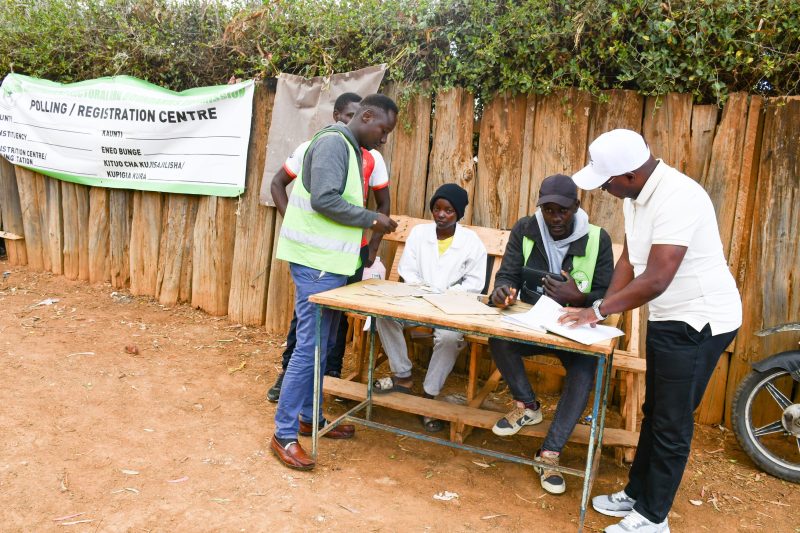
No original ID, No Vote: IEBC reminds Ol Kalou electorate
Abstract
The Independent Electoral and Boundaries Commission (IEBC) of Kenya has reiterated its firm stance that only an original National Identity Card or a valid Kenyan Passport will be accepted for voter identification at polling stations. This directive, recently highlighted for the Ol Kalou by-election, underscores the IEBC's commitment to electoral integrity and adherence to the established legal framework. This article delves into the constitutional and statutory underpinnings of this requirement, examining relevant provisions of the Constitution of Kenya, the Elections Act, 2011, and the Elections (General) Regulations, 2012, alongside pertinent judicial interpretations. It aims to provide legal professionals with a comprehensive understanding of the legal basis and implications of this crucial electoral rule.
Introduction
The Independent Electoral and Boundaries Commission (IEBC) recently issued a clear directive to the electorate of Ol Kalou, emphasizing that only an original National Identity Card or a valid Kenyan Passport would be accepted for voter identification at polling stations. This pronouncement, made in the context of an upcoming by-election, serves as a critical reminder of a fundamental requirement in Kenya's electoral process. The integrity of any democratic election hinges significantly on the accuracy and reliability of voter identification mechanisms.
This article aims to dissect the legal framework underpinning the IEBC's directive, providing legal practitioners with a detailed analysis of the constitutional and statutory provisions that mandate this strict identification policy. It will explore how this requirement balances the constitutional right to vote with the imperative for free, fair, and verifiable elections, drawing on key legislation and judicial pronouncements that have shaped Kenya's electoral jurisprudence.
Background
The right to vote in Kenya is a fundamental political right enshrined in Article 38 of the Constitution of Kenya, 2010, which grants every adult citizen the right to vote without unreasonable restrictions. Further, Article 81 sets out the general principles for the electoral system, emphasizing free, fair, and regular elections based on universal suffrage, transparency, and verifiability. To operationalize these constitutional mandates, Parliament enacted the Elections Act, 2011, which, along with its subsidiary legislation, including the Elections (General) Regulations, 2012, and the Elections (Registration of Voters) Regulations, 2012, forms the bedrock of Kenya's electoral law.
The Independent Electoral and Boundaries Commission (IEBC), established under Article 88 of the Constitution, is tasked with the crucial responsibility of conducting and supervising elections and referenda. Its mandate includes the continuous registration of citizens as voters, maintaining an accurate and up-to-date register of voters, and ensuring the integrity and accuracy of the electoral process. Central to this mandate is the establishment of clear procedures for voter registration and identification, designed to facilitate legitimate participation while safeguarding against electoral malpractice.
Analysis
The IEBC's requirement for an original National Identity Card or a valid Kenyan Passport for voting is firmly rooted in Kenyan electoral law. Section 3(1) of the Elections Act, 2011, stipulates that the right to vote, as specified in Article 38(3) of the Constitution, shall be exercised in accordance with the Act. Crucially, Section 3(2) further clarifies that a citizen shall only exercise the right to vote if they are registered in the Register of Voters. The process of registration itself, as outlined by the IEBC, necessitates the presentation of original identification documents. The IEBC's "How to Register" guidelines explicitly state that an eligible voter must present their original identification documents (ID card or valid Kenyan passport) to the registration officer, and being without these documents is a ground for denial of registration. This is further supported by Regulation 13 of the Elections (Registration of Voters) Regulations, 2012, which specifies the permissible identification documents for voter registration.
At the polling station, the identification process is governed by Regulation 69 of the Elections (General) Regulations, 2012, which outlines the voting procedure. While the regulations do not explicitly state "original ID," judicial interpretations and IEBC directives have consistently affirmed this requirement. The Supreme Court, in the landmark 2017 Presidential Election Petition (Raila Amolo Odinga & Stephen Kalonzo Musyoka v Independent Electoral and Boundaries Commission), emphasized the IEBC's responsibility to comply with constitutional and statutory provisions, including the use of biometric technology for voter identification. The Court noted that biometric verification is the primary mode of identifying voters, with complementary mechanisms like alphanumeric search and the printed register available only in cases of biometric system failure, and even then, requiring the voter to fill Form 32A. This highlights the emphasis on verifiable and authentic identification.
Recent High Court rulings have also affirmed the importance of these identification documents. For instance, a May 2025 judgment by Justice Lawrence Mugambi upheld that Section 5(3) of the Elections Act provides for evidence of eligibility for voter registration through the national ID or passport, reinforcing their foundational role in the electoral process. While there was a temporary High Court order in 2022 (Okiya Omtatah Okoiti -V- The Hon. Attorney & IEBC) allowing diaspora Kenyans to register with either a valid passport or Kenyan ID, this further underscores that both documents are the legally recognized forms of identification. The strict adherence to original documents is a measure to prevent voter impersonation and maintain the sanctity of the ballot, aligning with the constitutional principle of free and fair elections.
Conclusion
The IEBC's directive requiring an original National Identity Card or a valid Kenyan Passport for voting is not an arbitrary administrative hurdle but a legally entrenched safeguard designed to uphold the integrity of Kenya's electoral process. This requirement is firmly anchored in the Constitution of Kenya, 2010, the Elections Act, 2011, and the Elections (General) Regulations, 2012, and has been consistently affirmed by judicial pronouncements. It serves to ensure that only genuinely registered and identified voters cast their ballots, thereby preventing fraud and enhancing the credibility of election outcomes.
For legal practitioners, it is imperative to advise clients, including political parties, candidates, and voters, on the strict adherence to this identification requirement. Any deviation or attempt to circumvent this rule could lead to disenfranchisement or legal challenges to election results. As Kenya continues to refine its electoral processes, the emphasis on verifiable and authentic voter identification remains a cornerstone of its democratic aspirations, underscoring the delicate balance between facilitating the right to vote and ensuring the sanctity of the ballot.
Citations
- 1.Constitution of Kenya, 2010
- 2.Elections Act, 2011 (No. 24 of 2011)
- 3.Elections (General) Regulations, 2012 (Legal Notice No. 128 of 2012)
- 4.Elections (Registration of Voters) Regulations, 2012
- 5.Independent Electoral and Boundaries Commission, "How to Register"
- 6.Raila Amolo Odinga & Stephen Kalonzo Musyoka v Independent Electoral and Boundaries Commission, Chairperson Independent Electoral and Boundaries Commission & Uhuru Muigai Kenyatta (Election Petition 1 of 2017) [2017] KESC 31 (KLR)
- 7.High Court Constitutional Petition No. E004 of 2022 - Okiya Omtatah Okoiti -V- The Hon. Attorney & IEBC
- 8.High Court ruling by Justice Lawrence Mugambi, May 2025 (regarding Section 5(3) of the Elections Act and Regulation 37)
How does this affect your business?
Get an AI analysis of this article grounded in your jurisdictions, practice areas, and any policy documents you've uploaded to Wansom.