
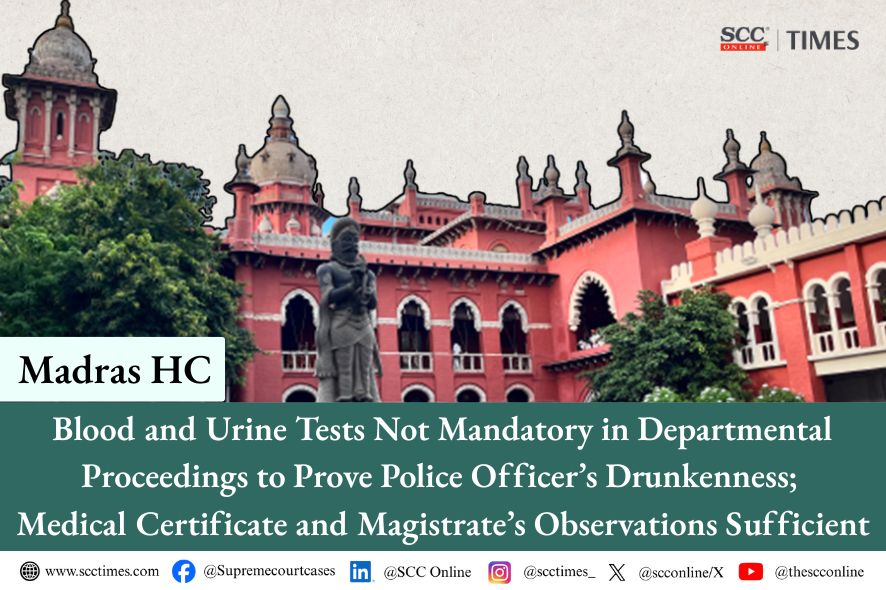
Madras HC: Blood and Urine Tests Not Mandatory in Departmental Proceedings to Prove Police Officer’s Drunkenness; Medical Certificate and Magistrate’s Observations Sufficient
Abstract
The Madras High Court has ruled that blood and urine tests are not mandatory in departmental proceedings to prove a police officer's drunkenness. The court held that a medical certificate issued by a doctor, along with the observations of a judicial magistrate, is sufficient to establish misconduct. This decision may have implications for disciplinary proceedings against law enforcement officers.
Introduction
The Madras High Court has recently delivered a ruling in a case concerning departmental proceedings against a police officer accused of drunkenness. The court's decision has significant implications for the conduct of such proceedings, which are often used to discipline officers for misconduct. In this article, we will examine the key points of the ruling and its potential impact on law enforcement disciplinary procedures.
Background
Departmental proceedings against police officers are governed by various statutes and regulations in India. The Code of Criminal Procedure, 1973, and the Police Act, 1861, provide for the conduct of such proceedings. However, the specific requirements for proving misconduct, including drunkenness, have been subject to interpretation. In this case, the Madras High Court was called upon to consider whether blood and urine tests are mandatory in establishing a police officer's drunkenness.
Analysis
The court's ruling is significant because it establishes that blood and urine tests are not necessary to prove a police officer's drunkenness. Instead, a medical certificate issued by a doctor and the observations of a judicial magistrate may be sufficient to establish misconduct. This decision may have implications for disciplinary proceedings against law enforcement officers, as it provides an alternative means of proving misconduct without relying on physical evidence.
Conclusion
The Madras High Court's ruling has significant implications for law enforcement disciplinary procedures in India. Practitioners should take note of this development and consider its potential impact on future cases involving departmental proceedings against police officers.
How does this affect your business?
Get an AI analysis of this article grounded in your jurisdictions, practice areas, and any policy documents you've uploaded to Wansom.