
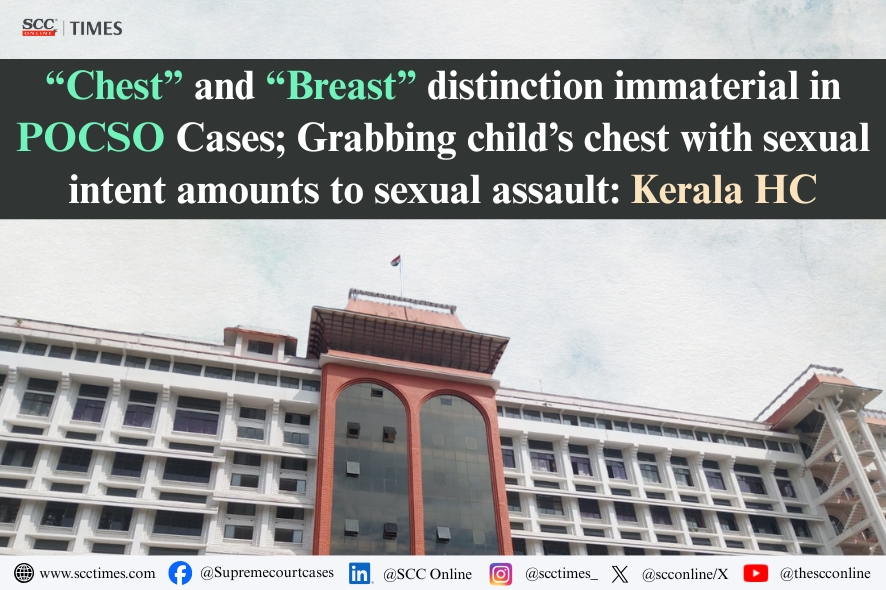
Kerala HC POCSO Ruling: Chest vs Breast Distinction Immaterial
Summary
- The Kerala High Court held that grabbing a child's chest with sexual intent amounts to sexual assault under the POCSO Act.
- The court rejected the distinction between 'chest' and 'breast', stating it is irrelevant in cases involving child victims.
- This ruling has significant implications for lawyers handling POCSO cases, particularly when it comes to drafting charges and defense strategies.
What Happened
The court held that grabbing a child's chest with sexual intent amounts to sexual assault under the POCSO Act.
In a significant ruling, the Kerala High Court has clarified that in cases involving child victims of sexual assault, the distinction between 'chest' and 'breast' is immaterial. The court held that grabbing a child's chest with sexual intent amounts to sexual assault under the Protection of Children from Sexual Offenses (POCSO) Act. This ruling has significant implications for lawyers handling POCSO cases in India.
The court's decision was made in response to a case where a man was accused of sexually assaulting a minor. The prosecution argued that the act constituted sexual assault, while the defense claimed that it did not since the perpetrator had only touched the child's chest and not their breast. However, the court rejected this argument, stating that the distinction between 'chest' and 'breast' is irrelevant in cases involving child victims.
Legal Context
The POCSO Act was enacted to protect children from sexual offenses and provide a robust framework for investigating and prosecuting such crimes. The act defines sexual assault as any intentional physical contact with the body of a child, with or without penetration, with sexual intent. In this context, the Kerala High Court's ruling is significant because it clarifies that the distinction between 'chest' and 'breast' is not relevant in cases involving child victims.
This ruling has implications for lawyers handling POCSO cases, particularly when it comes to drafting charges and defense strategies. Lawyers should note that this decision may impact their approach to describing the act of sexual assault, as the court's interpretation emphasizes the importance of considering the factual context rather than relying on strict anatomical distinctions.
Why It Matters
The Kerala High Court's ruling has far-reaching implications for child protection laws in India. By clarifying that the distinction between 'chest' and 'breast' is immaterial in cases involving child victims, the court has provided a more nuanced understanding of what constitutes sexual assault under the POCSO Act.
This decision is particularly significant because it highlights the need to consider the factual context when interpreting the act of sexual assault. This approach will help ensure that child victims receive justice and protection from sexual offenses. The ruling also underscores the importance of providing training to law enforcement officials, prosecutors, and judges on the POCSO Act and its provisions.
Practical Implications
Lawyers should note that this ruling may impact their approach to drafting charges and defense strategies in POCSO cases, particularly when it comes to describing the act of sexual assault.
Source
Source: Original reporting via SCC Times
How does this affect your business?
Get an AI analysis of this article grounded in your jurisdictions, practice areas, and any policy documents you've uploaded to Wansom.