
Ethiopia Set for USD 295mln New Development Bank Buy-In
Abstract
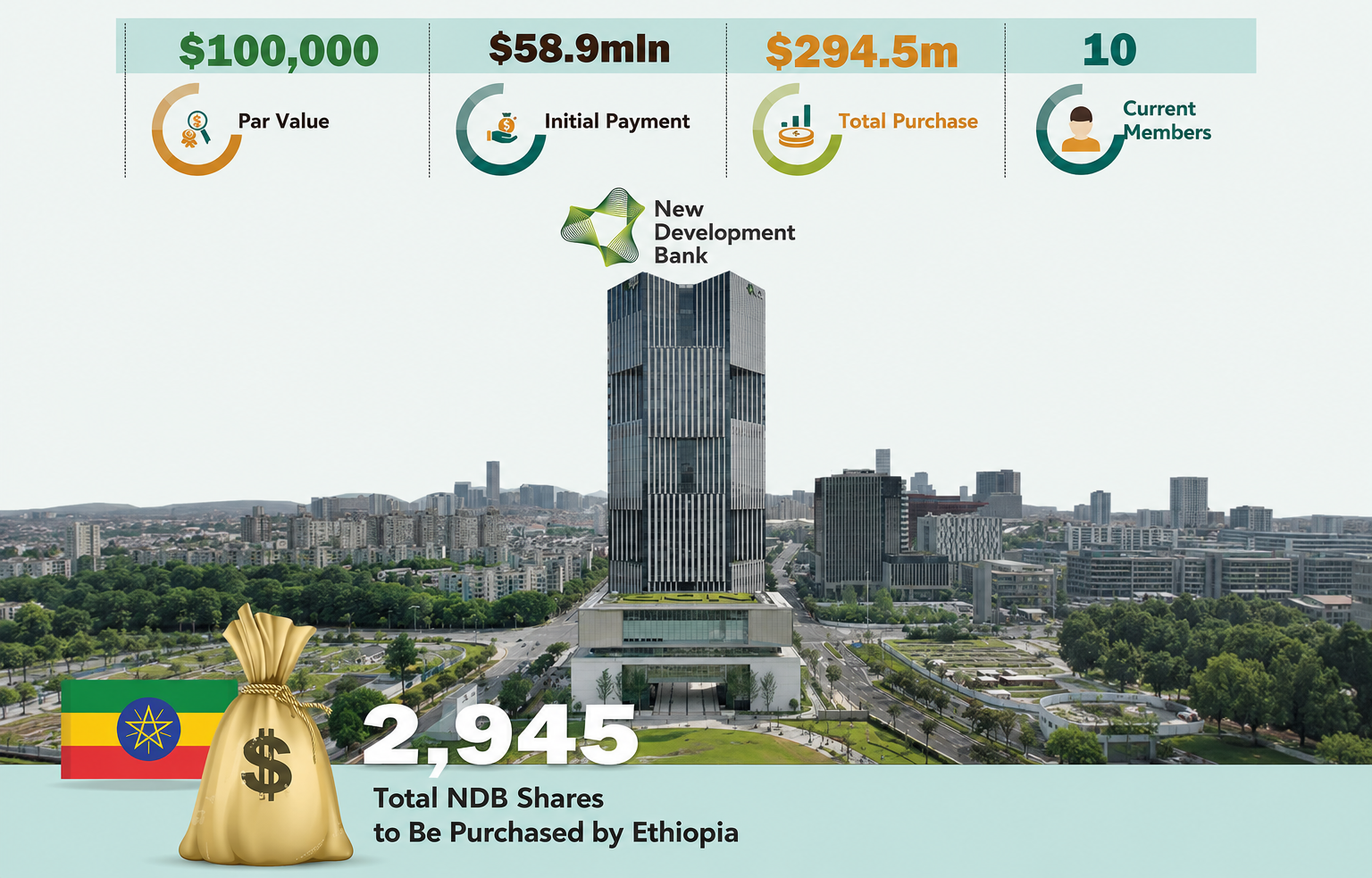
Ethiopia is poised to become a member of the BRICS-led New Development Bank (NDB) with its Parliament set to approve a proclamation for the purchase of 2,945 shares, valued at USD 100,000 each, amounting to a total buy-in of USD 295 million. This move, following the Council of Ministers' endorsement, signifies Ethiopia's strategic pivot towards diversifying its development finance sources and strengthening South-South cooperation. The membership is anticipated to unlock new avenues for funding critical infrastructure and sustainable development projects, enhance macroeconomic stability, and integrate international agreements into domestic law upon ratification, thereby granting the NDB legal recognition and operational privileges within Ethiopia.
Introduction
Ethiopia is on the cusp of a significant shift in its development finance strategy, with its Parliament expected to ratify a proclamation that will formalize the nation's membership in the New Development Bank (NDB). This follows the recent endorsement by the Council of Ministers, paving the way for Ethiopia to acquire 2,945 shares in the NDB, each valued at USD 100,000, culminating in a substantial investment of USD 295 million.
This impending membership represents a strategic alignment for Ethiopia, signaling a deliberate move towards alternative multilateral financial institutions and a deeper engagement with South-South cooperation frameworks. For legal practitioners, this development necessitates a thorough understanding of the NDB's operational and legal framework, as well as the domestic legal processes governing the ratification and implementation of international financial agreements. The article will delve into the legal implications of this accession, examining the procedural steps, the NDB's mandate, and the anticipated benefits and obligations for Ethiopia.
Background
The New Development Bank (NDB) was established by the BRICS nations (Brazil, Russia, India, China, and South Africa) during the 6th BRICS Summit in Fortaleza, Brazil, on July 15, 2014, and became fully operational in 2015. Headquartered in Shanghai, its primary purpose is to mobilize resources for infrastructure and sustainable development projects in BRICS and other emerging economies and developing countries, thereby complementing the efforts of existing multilateral and regional financial institutions.
The NDB commenced with an initial authorized capital of USD 100 billion, divided into one million shares with a par value of USD 100,000 each, and an initial subscribed capital of USD 50 billion, equally distributed among its founding members. Membership is open to members of the United Nations, subject to terms and conditions determined by the NDB's Board of Governors, with a stipulation that the founding BRICS members collectively retain at least 55% of the total voting power. Ethiopia's accession follows a trend of expansion, with countries like Bangladesh, Egypt, the United Arab Emirates, Algeria, and Uzbekistan having joined in recent years.
Domestically, Ethiopia's legal framework for ratifying international agreements is primarily governed by its Constitution. Article 9(4) of the Constitution of the Federal Democratic Republic of Ethiopia (FDRE) stipulates that all international agreements ratified by Ethiopia become an integral part of the law of the land. The process typically involves endorsement by the Council of Ministers, followed by parliamentary approval through a proclamation by the House of Peoples' Representatives (HoPR).
Analysis
Ethiopia's journey to NDB membership involves a clear, multi-stage legal and political process. The initial step, the endorsement of a draft proclamation by the Council of Ministers, has already been completed. This action signifies the executive branch's approval of the terms of accession, including the financial commitment to purchase 2,945 shares at USD 100,000 each, totaling USD 295 million. The payment structure involves an upfront payment of 20% (USD 58.9 million), with the remaining balance to be paid in 14 installments over 13.5 years.
The next critical stage is the parliamentary approval by the House of Peoples' Representatives (HoPR). Under the FDRE Constitution, particularly Article 55(12), the HoPR is vested with the power to ratify international agreements. Once ratified through a proclamation, the NDB Agreement, along with its Articles of Agreement, will become an integral part of Ethiopian law, as mandated by Article 9(4) of the Constitution. This legal integration is crucial, as it grants the NDB legal recognition within Ethiopia, allowing it to enter into agreements, own property, engage in legal affairs, and benefit from tax and customs exemptions, as outlined in the proposed membership agreement.
Membership in the NDB carries significant implications. From a financial perspective, it provides Ethiopia with access to a new source of development financing, particularly for infrastructure and sustainable development projects in sectors like agriculture, energy, and industry. This diversification reduces reliance on traditional Western-dominated financial institutions and aligns with Ethiopia's broader strategy of strengthening South-South cooperation. The NDB's operational model, which emphasizes sound banking principles and cooperation with other financial entities, offers a complementary approach to development finance.
Furthermore, Ethiopia's accession will grant it a seat on the NDB board, providing a platform to influence the bank's policies and project priorities. The NDB's bylaws ensure that founding members' voting power does not fall below 55%, and non-founding members can hold voting shares of less than seven percent, indicating a governance structure that, while still influenced by its founders, allows for broader member participation. This engagement can enhance Ethiopia's economic diplomacy and foster stronger ties with BRICS nations and other emerging economies. Upon parliamentary approval, Ethiopia will complete its accession by filing an Instrument of Accession with the Brazilian government, as Brazil is the depository for the NDB Agreement.
Conclusion
Ethiopia's impending membership in the New Development Bank marks a pivotal moment in its economic and diplomatic trajectory, offering a strategic pathway to bolster its development finance landscape. For legal practitioners, this development underscores the growing importance of understanding the legal frameworks of multilateral development banks and the intricacies of international treaty ratification within the Ethiopian context. Lawyers advising on project finance, infrastructure development, and international trade will need to familiarize themselves with the NDB's operational guidelines, procurement policies, and dispute resolution mechanisms, as these will directly impact future projects funded by the institution.
Looking ahead, practitioners should closely monitor the parliamentary proceedings for the final ratification proclamation and any subsequent implementing regulations. The successful integration of the NDB Agreement into Ethiopian law will create new legal avenues and considerations for both public and private sector engagements. This move not only promises enhanced access to capital for Ethiopia's ambitious development agenda but also solidifies its commitment to a more multipolar global financial architecture, presenting both opportunities and challenges that will require astute legal navigation.